
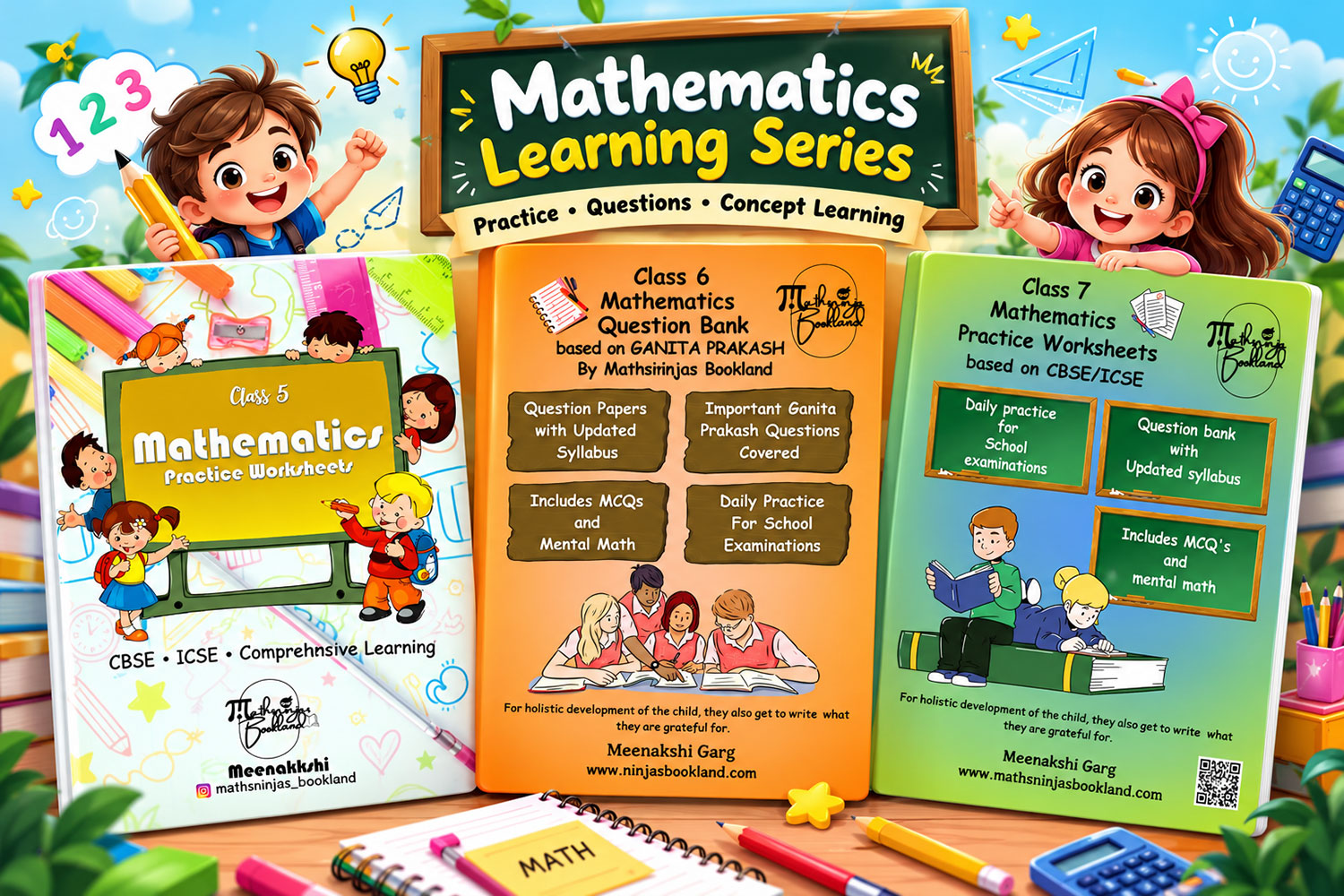
Best Maths Practice Books for Class 1 to 8: A Parent’s Guide
Mathematics is an essential part of a child’s learning journey. From understanding numbers and basic calculations in primary classes to learning fractions, decimals, algebra and geometry in middle school, children need regular practice to build strong mathematical skills.
Choosing the right maths practice book can help children revise school lessons, improve calculation accuracy and develop problem-solving abilities. The best maths practice books for Class 1 to 8 should match a child’s learning level, explain concepts clearly and provide opportunities to practise different types of questions.
At Ninjas Bookland, parents can explore maths workbooks, question banks and mental maths resources for different classes. This guide explains how to choose suitable books, what children should practise at each stage and how parents can make mathematics easier to learn at home.
Why Are Maths Practice Books Important for Children?
Maths practice books provide additional exercises that help children understand and apply concepts taught at school. Regular practice strengthens number skills, improves calculation accuracy and encourages independent learning.
Workbooks also help children identify topics that require more attention. Chapter-wise exercises support revision, while mixed questions encourage children to select the correct method independently. Word problems develop logical thinking by helping children understand how mathematics applies to everyday situations.
With consistent practice and parental support, children can gradually become more confident in solving mathematical problems.
How to Choose the Best Maths Practice Books for Class 1 to 8
Before purchasing a workbook, consider your child’s class, current abilities and school syllabus. A book that is too difficult may cause frustration, while an overly simple workbook may not provide enough learning opportunities.
Choose a maths practice book that explains concepts clearly and includes suitable exercises for the child’s learning stage. Chapter-wise questions, mental maths, mixed practice and real-life word problems can support a balanced learning experience.
Parents should also check the publication date and syllabus coverage before purchasing. Since curriculum requirements and book editions may change, always compare the product description with the topics taught at your child’s school.
Best Maths Practice Books for Each Class: Class 1 to Class 8
Children develop different mathematical skills as they progress through school. Selecting an appropriate workbook for each class helps them strengthen existing knowledge and prepare for more advanced concepts.
Maths Practice Books for Class 1
Class 1 focuses on building a foundation in numbers and basic calculations. Children begin learning number recognition, place value, addition, subtraction, shapes, time and money.
A suitable workbook should provide simple exercises that make learning enjoyable and help children understand numbers through practical examples. Parents can explore the Grade 1 Maths Workbook CBSE/ICSE at Ninjas Bookland and check its listed topics before purchasing.
Parent tip: Use everyday objects such as pencils, toys or fruit to demonstrate counting and simple calculations.
Maths Practice Books for Class 2
In Class 2, children develop greater confidence in addition and subtraction while beginning to explore multiplication, division and number patterns. They also practise basic measurement, money and time-related questions.
A Class 2 maths workbook can reinforce these skills through regular calculations and word problems. Parents can explore the Grade 2 Maths Workbook CBSE/ICSE at Ninjas Bookland for additional practice.
Parent tip: Ask your child to explain how they arrived at an answer instead of focusing only on whether it is correct.
Maths Practice Books for Class 3
Class 3 introduces more challenging calculations and strengthens multiplication and division skills. Children also practise fractions, measurement, calendars, time and basic data handling.
A structured workbook helps students revise these topics and apply their knowledge to word problems. Parents can review the Class 3 Maths Practice Workbook available at Ninjas Bookland, checking that its edition matches the current school syllabus.
Parent tip: Encourage children to identify important information in word problems before choosing a mathematical operation.
Maths Practice Books for Class 4
By Class 4, children begin solving more complex problems involving multiplication, division, factors, multiples, fractions and decimals. Geometry, perimeter, measurement and unit conversions also become important learning areas.
A good practice workbook should balance calculation exercises with concept revision and mixed questions. Parents can explore the Class 4 Mathematics Practice Workbook at Ninjas Bookland to find a suitable supplementary resource.
Parent tip: Use shopping, cooking and daily schedules to demonstrate practical applications of mathematics.
Maths Practice Books for Class 5
Class 5 helps children prepare for middle school mathematics. Students need to strengthen arithmetic skills and become comfortable with multi-step problems involving fractions, decimals, measurement, geometry, area and perimeter.
A Class 5 maths workbook can support revision and improve accuracy through regular exercises. Parents can explore the Grade 5 Maths Workbook CBSE/ICSE at Ninjas Bookland and verify its syllabus coverage before ordering.
Parent tip: Encourage your child to write each step when solving longer questions so that mistakes are easier to identify.
Maths Practice Books for Class 6
Class 6 introduces more advanced mathematical concepts and encourages independent learning. Depending on the curriculum, students may practise whole numbers, fractions, decimals, algebraic thinking, geometry, measurement and data handling.
Regular practice helps children understand these topics and develop better problem-solving skills. Ninjas Bookland lists maths question banks and practice resources for Class 6, including a resource based on the newer NCERT Ganita Prakash curriculum.
Parent tip: Let children attempt questions independently before providing hints or showing worked examples.
Maths Practice Books for Class 7
Class 7 mathematics requires stronger conceptual understanding and the ability to solve multi-step problems. Students may study rational numbers, percentages, algebraic expressions, equations, geometry and data interpretation, depending on their syllabus.
A suitable workbook should help students revise concepts and apply mathematical methods to unfamiliar questions. Parents can browse the Maths Books collection at Ninjas Bookland and compare available Class 7 resources with their child’s current curriculum.
Parent tip: Discuss why a solution works instead of concentrating only on the final answer.
Maths Practice Books for Class 8
Class 8 maths practice helps students consolidate important concepts before progressing to higher classes. Depending on the syllabus, students may work on rational numbers, exponents, algebra, geometry, mensuration, percentages and data handling.
Regular revision and application-based questions can help children improve their understanding and prepare for school assessments. Explore the Maths Books collection at Ninjas Bookland and check the relevant product descriptions for Class 8 resources.
Parent tip: Maintain a notebook of difficult questions and revisit them after a few days to check understanding.
Maths Workbook vs. Textbook: What Is the Difference?
A maths textbook introduces concepts and explains mathematical rules, while a practice workbook provides additional opportunities to apply them. Textbooks generally support classroom learning, whereas workbooks help children reinforce lessons, practise different question types and identify areas that need improvement.
Both resources are useful and should complement each other. A practice book is not intended to replace the prescribed school textbook or teacher guidance.
How Much Maths Practice Should Children Do Daily?
The ideal practice time depends on a child’s age, attention span, school workload and learning needs. Short, consistent sessions are often easier to maintain than long study periods.
As a flexible starting point, children in Classes 1–2 may practise for 10–15 minutes daily, Classes 3–5 for 15–20 minutes, and Classes 6–8 for 20–30 minutes. These are suggestions rather than strict requirements and should be adjusted according to the child’s comfort and progress.
A simple routine can include reviewing a recently taught concept, solving a few workbook questions, attempting one challenging problem and checking mistakes. Recognising effort and improvement can also make learning more enjoyable.
How Can Parents Make Maths Practice More Effective?
Parents can make maths practice more productive by choosing exercises that address their child’s specific learning needs. If a child struggles with multiplication, revisit the basic concept before introducing difficult questions. If calculations are accurate but slow, short mental maths exercises may help.
Encourage children to understand mathematical methods rather than memorising answers alone. Drawings, objects and real-life examples can make difficult concepts easier to understand.
Allow children to make mistakes without fear. Ask them to explain their approach, review incorrect steps and try another method when necessary. Regular revision, patience and positive encouragement can help children develop confidence over time.
Everyday activities such as counting objects, comparing prices, measuring ingredients and reading calendars also provide opportunities to practise maths naturally.
Where Can You Find Maths Practice Books for Class 1 to 8?
Ninjas Bookland offers a Maths Books collection where parents can explore available workbooks, question banks and mental maths resources for different classes.
Before selecting a book, choose the appropriate class, review its product description and verify the topics against your child’s current school syllabus. Select a resource that supports the child’s learning needs rather than purchasing multiple books without a clear purpose.
Explore the Maths Books collection at Ninjas Bookland to compare available learning resources.
